
becoming a eucharistic (adj.) person
outward signs of inward graces are literally everywhere
I’ve had a very churchy week.
Granted, most of my weeks are pretty churchy, but this one feels especially significant.
First, I started my transitional deaconate curacy, which is a type of professional placement for me to get on the job experience as a deacon alongside training to become a priest in a few months. By design, my placement at this church will last about six months, and I’ll attend events, assist with leading services, and meet regularly with the church’s clergy to learn from their work leading a parish. I will serve in the traditional roles of deacons in the Episcopal tradition while also receiving mentorship from the rector to enable reflection on what it means to inhabit the role of a priest, both practically and theologically.
My first event to attend at this church was their Episcopal 101 class which prepares new members for confirmation ahead of the Bishop’s visit in a couple of months. The subject of Thursday’s class was sacramentality and the sacraments. Though I’ve had theological courses on the sacraments, I so enjoyed learning more about them from the associate rector who taught this week’s class. I’ve been ruminating on the language she used, and it’s provided a framework for some vignettes I’ve been considering how to write about. More on that in a moment.
My other churchy activity this week, besides my regular work as a chaplain in an Episcopal-founded retirement community, was meeting with my instructor for the first of three sessions for my Practicing the Eucharist class. (I have three more classes to finish my certificate in Anglican studies; the other two are Anglican History and Anglican Ethics. God willing, I will be finished with them all by the end of May!)
My instructor, a retired priest and church historian, spoke eloquently about the eucharistic life and how presiding over the table is more than ceremonial actions. How we preside from a posture that inhabits the structure of the eucharist. How we practice the eucharist in order to become eucharistic people. I feel a sacred weight from the impending privilege of presiding over communion; already I cry just about every time I pass the chalice. Celebrating the eucharist at the altar is one of the things I’ve missed the most in this interim time between ordinations (I was previously ordained for eight years in a different protestant tradition). I have felt a sense of spiritual hunger for being at the altar again. Many days this feels like a confirmation of my calling to this vocation. I often wonder if I will be able to do it without crying.
I’m enlivened by the conversations I had with my instructor today, with hope that our time together will help me better inhabit this vocation to which I’ve been called.
In recent weeks, I’ve experienced a few sacred moments I wanted to write about but I was unsure of how to go about it. The sacraments class at my curacy church provided just the lens I needed to articulate what those moments mean to me.
There are seven recognized sacraments of the Christian church. A sacrament is what 17th century Anglican priest John Wesley called “an outward sign of an inward grace.” The seven sacraments are baptism, holy communion, confirmation, holy matrimony, ordination, reconciliation/confession, and anointing of the sick. The first two, baptism and communion, are instituted by Jesus Christ and are considered initiation rites in most Christian traditions. The other five are more or less optional and will not apply to every Christian.
In the class for new Episcopalians, Mtr. Rita explained how each sacrament provides an outward sign of something God is doing inwardly in our hearts.
Baptism’s inward grace is new life in Christ.
The Eucharist’s inward grace is the real presence of Christ.
Confirmation’s inward grace is empowerment for ministry.
Marriage’s inward grace is a covenantal relationship.
Ordination’s inward grace is vocational calling to ministry in the church.
Confession’s inward grace is amendment of life.
Anointing’s inward grace is healing “in the deepest possible sense.” (Mtr. Rita)
These are the seven official sacraments of the church, but of course there are plenty of other sacraments by which we know the presence of Christ. Rachel Held Evans wrote, “The tangible, tactile nature of the sacraments invited me to touch, smell, taste, hear, and see God in the stuff of everyday life again. They got God out of my head and into my hands. They reminded me that Christianity isn’t meant to simply be believed; it’s meant to be lived, shared, eaten, spoken, and enacted in the presence of other people.”
Below are seven stories, seven encounters in which someone offered me an outward sign of God’s inward grace. Their lives and generous spirits are, to me, a sacrament.
Sometime in the night, perhaps between midnight and 2:00am, my daughter makes her way from her bedroom to mine. I feel her knobby knees as she crawls into her space tucked between my husband and me in our increasingly small queen sized bed. I used to lift my left arm so she could find her place in its crook, but these days she likes to be the big spoon. She pushes her chest to my back as close as she can manage, throwing her arm around my arm, and I feel her breath on my neck. Soon, she’s snoring. I wake a bit later to her absence; she has turned herself around and I feel envious when I see she has reallocated her generous cuddles to her dad. They snore in tandem. Eventually she will do what we call her “starfish,” when she puts and arms and legs outstretched on each of us, totally satisfied with the arrangement she’s made for herself.
Night after night, this is an outward sign of our covenantal relationship, a marvelous grace that she is mine.
I make my way around the chapel, distributing the bread of holy communion. I take my time and say the name of each person to whom I give the bread. Mary, the body of Christ, the bread of heaven. Jim, the body of Christ, the bread of heaven. Helen, the body of Christ, the bread of heaven. The priest follows me with the chalice, offering the blood of Christ, the cup of salvation. We partner in this work of imparting Christ’s body, a means of grace, to the people of our congregation. It takes the time it takes, and people don’t seem rushed or concerned. We share in this sacrament together.
After the service, greeting people as they exit, a man pulls me close. He is legally blind, only able to see as if looking through a drinking straw. With tears on his cheeks he says, “When you said my name and gave me communion, I saw the face of Jesus in your face.”
I tuck away this encounter in my heart for safe keeping. This sacred connection is an outward sign that empowers me for ministry. My call is not something I made up in my own mind but is a gift from God that enables me to bring Christ to those in my care.
I have been ordained to the deaconate for two weeks. I meet with my spiritual director Denise and share my anxieties for the future. We discuss what it might look like for me to approach impending changes with curiosity for the call instead of anxiety about the logistics. I think about our previous meetings in gardens and other sacred spaces in this city that has become a home. I think of what a kindred spirit this woman has become and how trustworthy she is with the quandaries of my spiritual life. I thank God for her and for my friend Christy who introduced us.
Later in the week, Denise sends me photos of her ordination stoles from her own ordination in 1986, offering me one to keep. We are the same height, so this is a gift of the spirit as much as it is one with practical weight. Tall girls need long stoles! A fair few of the vestments I’ve inherited were made for women much shorter than me. Denise sees me in my fullness and offers an outward sign of an inward grace, a shared call to vocational ministry, weaving the threads of her ordination story with mine.
It’s the middle of week and so it is time for me to make my way to a dear resident’s apartment. He’s expecting me, always saying that my visits are a great comfort. Sometimes we talk about Kansas City’s history. Other times we talk about events from his week. Always we pray the prayer of confession. This is his choice. He asked me to come and pray it with him every week, as there’s something about the prayer that is deeply important to him. I ask what part of the prayer he likes best, and he says, “What we have left undone…” I wonder what he is thinking, what part of his nearly-ten decades-of-life he’s remembering. I hold his hand. He leans his head against mine. He brings my hand to his mouth and he kisses it, an outward sign of our shared petition for forgiveness and awareness of God’s grace that is greater than all our sins.
It’s time for midweek devotions in the skilled nursing unit. Fifteen or sometimes twenty of us gather to sing hymns at a pace that sounds like a podcast set to one and half times its speed. Our pianist is delightful, truly, in every sense of the word. He also plays the piano like he’s running out of time and it’s going out of style. We run out of breath as we make our way through Holy, Holy, Holy, Bringing in the Sheaves, and Lift Every Voice and Sing. At the end of our fifteen song marathon, I make my way around the room to offer words of blessing and love to each person there. I approach a man who is a retired deacon in the church. As his disease progresses, he is increasingly confused about his setting and he often believes he is in an active ministry role (one could argue that he is in an active ministry role). I approach him to offer a word of love, and before I can say anything he puts his hand on the crown of my head and utters his own words of blessing. I can’t understand what he’s saying, but I don’t need to. I feel the meaning he conveys, and I cry as I receive his encouragement. He anoints me, offering healing and wholeness in the deepest sense, and I feel him passing the torch from his deaconate to mine. An outward grace entirely unique to any I have experienced before, bringing to mind the Bishop’s hands on my head ordaining me for ministry just a few short weeks ago.
The devotion offered today is one of remembrance. Battery operated tealights flicker as nineteen people hold them in their hands, considering those they’ve lost to death. We go around the room, each naming their deceased with words of affection and care. We remember them all together. One woman is deeply affected by memory loss and confusion. I wonder if she will understand the question, “Who would you like to remember today?” So instead I ask her, “Who do you love?” Her bright blue eyes connect with mine. With conviction she says, “YOU.” Tears well in my eyes as I tell her that I love her very much, too. I feel the very real presence of Christ in her sincere offer of affection, an outward sign of the inward grace extended through our relationship with one another.
The Memory Care unit opens where I work. Two people move in, disoriented by their new surroundings. They begin to settle, ever gradually, seeming less distressed by the changes they’ve experienced. I visit them for devotions twice each week, reintroducing myself each time. We enjoy a pleasant conversation and I’m moved by one of their reflections of the Godly Play story for creation. I used to swim. I like the fish. That one looks sad.
I send a request to the clergy of the diocese for communion supplies. The residents of memory care cannot come to the community chapel, so I bring chapel to them. A retired priest responds, offering me the portable communion set he was given when he was ordained in the 1970s. He is glad to know it will be used. He delivers the set, and I marvel at the tiny chalice and paten, the petite candle sticks, and purificator the size of a tissue. I consider how the residents might engage with these elements and what they might remember as we set the table for communion under special circumstances. I wonder about how they might experience Christ at this stage of their lives, a new life made real through the elements when so much else has been forgotten. What is this breaking of bread if not an outward sign of the gifts of the Holy Spirit professed in our baptismal covenant, made known because of a person’s generous gift?
I wonder what sacramental moments you’ve had recently. How has the presence of God been made known to you? Where have you known outward signs of the inward grace always at work within you?
I didn’t make it to a coffee shop today due to my travels for class, but I did sit for a while at Big Whiskey in Jefferson City, enjoying loaded fries and a beer while I wrote.
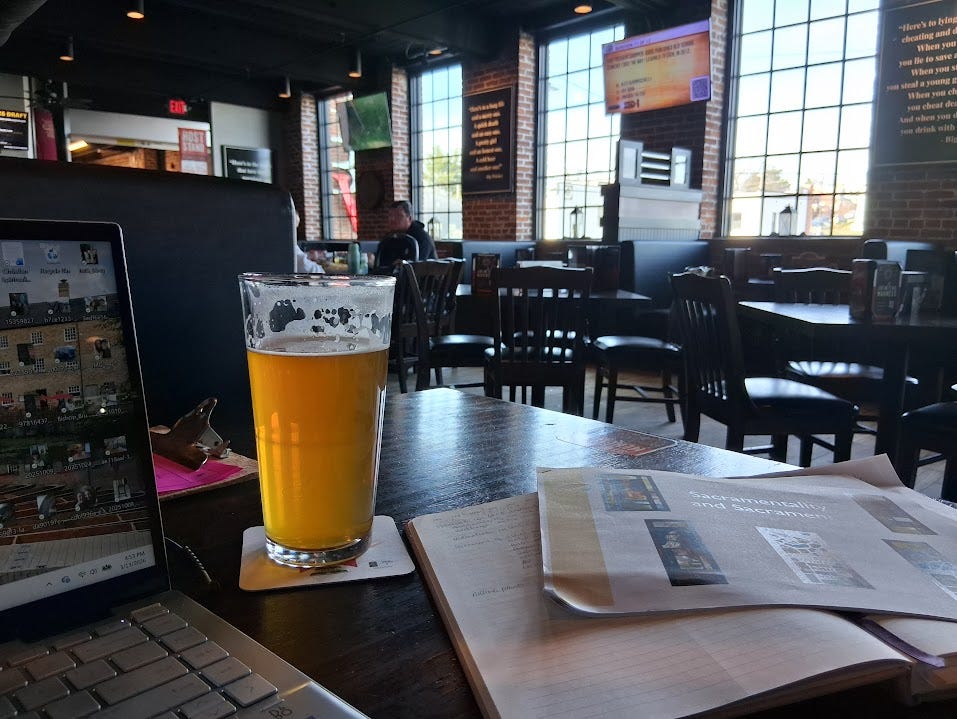
May you have a lovely weekend and experience the very real presence of Christ in ways that surprise and delight you.
Love to you,
Janette
Thankyou Janette for your moving piece this week. I was reminded of a phrase by Jean Pierre de Caussade that I came across when studying, which was powerful for me- “the Sacrament of the present moment “ I send my love and thanks for your writing and for being you!
Sue
wow wow wow- loved this piece!
I had a sacramental moment while volunteering at my church's meal program for marginalized communities. I usually am trying to be busy the entire time and fill in where needed. I saw two teens on their phones and caught myself getting frustrated. They're supposed to be volunteering like me! As I was thinking these thoughts, I caught myself and decided to STOP JUDGING and ask them if they needed help. Sure enough, they did and were looking at their phones to diagnose the issue they were having. As I spoke with them more, I noticed how sweet they were. I am grateful God gave me some grace in that moment.