
Finding meaning in bear hunts
& utilizing stories from unexpected places to explore life with God
I am the sort of preacher who often reaches for children’s books alongside my commentaries when preparing a sermon. Perhaps this a hangover from my training in the evangelical tradition as I don’t experience this style of preaching as often in the Episcopal Church. But I stand by the belief that we learn best through narrative, and it’s stories that generate some of our deepest connections with God and one another.
There’s a particular kind of joy in finding a fable or an iambic metered tale that offers just the right perspective I’m trying to convey. When I preached my first sermon postpartum, back in 2018, I read a portion of Love You Forever by Robert Munsch before reading a version I had written in the same rhythmic pattern to evoke God’s love for us despite our propensities to wander and doubt. That afternoon when friends from church were at our home, one asked to read the rest of the book I hadn’t included in the homily. He disappeared for ten minutes or so, returning with tears in his eyes after reading the ending. (Is it actually endearing or is it creepy? Jury is still out on that one…) I’ve often wondered if something about that homily’s meaning stuck with him beyond the end of the day because of the emotive response he had to the book.
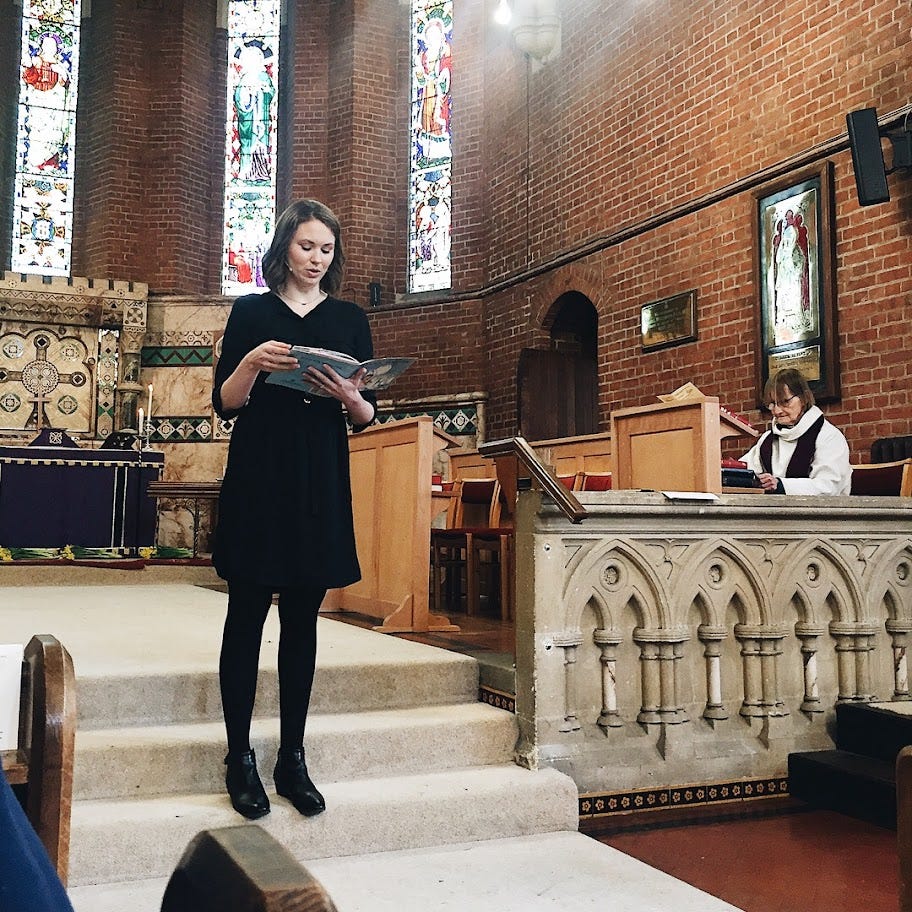
I’ve had to be extra careful with this approach as a chaplain in a senior living community. I’ve utilized children’s books and Godly Play stories with people across the life spectrum in many different contexts, but I learned quickly that senior adults are, understandably, prone to feeling infantilized as they age. This realization has made me all the more considerate and selective on the occasions I might feel inclined to reach for a beloved children’s book to tell a story. From the pulpit, it usually works. In a room exclusively full of people more than twice my age, it might work sometimes.
Wednesday was one of those such times. Twice each week I lead a devotions group in our skilled nursing area. Fifteen or so residents attend with varying degrees of physical and cognitive impairment. Some live there full time, and some are there for a few weeks or months for rehab. I know roughly half of them very well. I took the risk of bringing them a favorite board book from our house, We’re Going on a Bear Hunt by Michael Rosen.
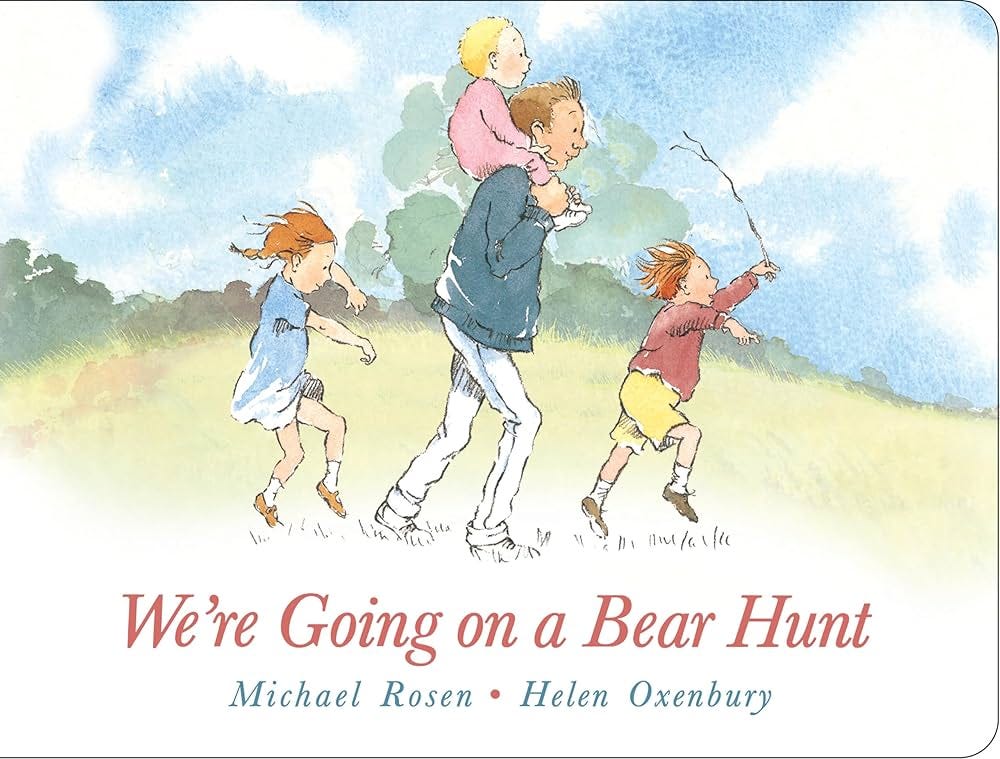
I began with an explanation. I told them of course I know that none of us present are children, but I asked if they had ever enjoyed a children’s book even when they were in adulthood. The group agreed that sometimes these simple stories offer a timeless wisdom, (and the pretty illustrations are great, too).
I then introduced this particular story, acknowledging we all know what it’s like to experience difficulty. I asked if there are some difficulties they couldn’t escape, but had to endure. Unsurprisingly, everyone in the room nodded. A few contributed, “Oh yes…” Knowing their stories the way I do, knowing the context of a skilled nursing home, I knew that many of them are here as a result of those very experiences that are still unfolding for them.
The delight of this particular book is that the story repeats. Every scenario begins with the same stanza:
We’re going on a bear hunt.
We’re going to catch a big one.
What a beautiful day!
We’re not scared.
But then, of course, the encounter something insurmountable. Tall wavy grass, a swirly snowstorm, thick oozy mud, and a deep river to name a few. (Alas, we did not attempt trying to understand where they were geographically to encounter such an assortment of issues.)
Each time they repeat,
“We can’t go over it. We can’t go under it. We’ve got to go through it.”
The residents and I took great delight in chanting those words together each time they appeared on the page. We laughed, we shouted out random solutions, we acted out the wind of the snowstorm. Curious staff members walked by and smiled; our joy and playfulness spreading like an invasive plant.
I finished reading and said, “I bet you know what that’s like.” Nods followed.
I said, “I wonder if we can make a list of the things that helped them get through it.”
The residents offered three things:
They were together. “WE are going on a bear hunt.”
They had hope. “What a beautiful day!”
They probably prayed to Jesus, asking him to be with him as they traversed the landscape. “We’re not scared.”
(And of course we all wondered… what were they doing going on a bear hunt in the first place if they were just going to run away from it in the end? A theological question for another day…)
Together we acknowledged the very real conundrums of our shared humanity and limitations, of the many things we simply have to go through because we can’t go under, over, or around them. Together, we acknowledged that hope is a tool of survival, and that we do not encounter these things alone.
Later in the day, one resident asked to speak with me. He said he hadn’t stopped thinking about the bear story. For the first time in the many months I’ve known him, he cried with me in grief for his many losses, and he acknowledged the hard reality that this is something he cannot escape but must go through. He asked big questions. He wonders about God’s will for his life now. He is unsure about the future. But he seemed to end the day with a renewed conviction that he is not solitarily enduring these things.
Sure, there are stories from scripture, tales of ancient saints, and scholarly explorations of theodicy. All worthwhile a good. But on this day? A story about a bear hunt was just the ticket to connect with a man whose troubles none of us has seen. That is the best outcome I could hope for on any day, much less on one that began with the offering of a board book.
The Christian faith is rooted in a story about a man, born as a baby, who worked and lived among us before he was crucified and then raised to life in a disabled body still bearing the wounds of his death.
Telling stories of our own encounters with Christ, or in this case, stories about a family on a bear hunt, is how we propagate the mystery.
Thank you for the reminder! I remember when I self-published a news letter years ago, I gave my parents copies of each edition. When the first one rolled out, and my Mother had read it, I asked her about it. She said, "You lost me after the first paragraph." I couldn't believe it! I said, "I don't think I can make it any simpler!" That conversation has always stuck with me. When I write, I ask that question, "Can this be simpler?" Instead, I think I'll start asking, "How can I explain this in a children's board book?"